Jack sewing article
Your Sewing Machine Output Is a Setup Problem, Not a Machine Problem
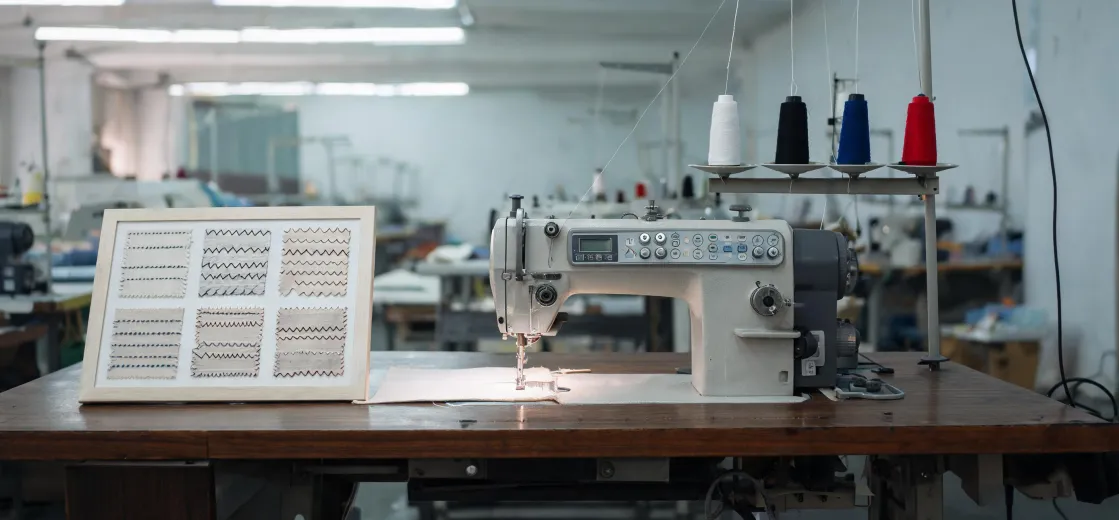
When I took over purchasing for a 45-person garment and embroidery shop in 2020, the production manager handed me a list of machine issues. Skipped stitches. Thread breaks. Uneven seams on a line that had been running the same way for months. My first instinct was to look for replacement machines. That felt logical. I was wrong, but it took me three months and a bad batch to understand why.
Here's what I didn't know at the time: the machines were old, but they weren't broken. The problem was how they were set up. And the more I learned, the more I realized that most 'machine problems' in a sewing room are actually setup problems wearing a machine's clothing.
The machine problem that wasn't
We had a single-head embroidery machine that kept producing light, uneven stitches on a heart-shaped design. The operator was convinced the tension assembly was worn. A technician was quoted for a service call. Then the owner asked for something we should have done weeks earlier: stitch a test piece and watch the presser foot while it ran.
One observation changed the diagnosis. The presser foot was lifting slightly on the left side. Every cycle, the fabric shifted a tiny amount. By the time the heart design finished, the layers were misaligned. Not by much. Just enough to make the design look amateur.
We didn't need a new machine. We needed a presser foot that actually sat flat.
What 'sewing machine output' really means
If you search for 'sewing machine output' you'll get definitions about stitches per minute and piece rates. That's useful for ranking machines, but it doesn't tell you what your workshop can sell. Usable output is what matters. A machine can run at 5,000 stitches per minute and still produce nothing but rejected pieces if the foot is wrong, the needle is dull, or the tension is off.
In an embroidery machine workshop, the gap between gross output and good output is even bigger. A design can be running for an hour before someone notices that the bobbin tension changed. That's not a machine failure. That's a setup and monitoring failure.
The hidden problem: the presser foot
When I first started managing equipment purchases, I thought a presser foot was a presser foot. Basic black metal, a hole in the middle, a screw on top. What could go wrong?
Turns out, a lot.
The foot controls how much fabric gets pulled under the needle on every stroke. If the foot is bent, worn, or slightly wrong for the material, the feed dogs do their job unevenly. The result is skipped stitches, puckered seams, or a design that drifts off center. The needle looks fine. The thread path is clean. The machine is healthy. The output is still garbage. Foot, needle, thread path, tension. In that order.
A good example: we had a Brother industrial machine that was skipping stitches only on thick denim. The obvious suspect was the needle. The real issue was the foot. The gap under a standard foot wasn't big enough for the layered seams. We replaced it with an industrial Brother sewing machine foot designed for heavy material. The same machine started stitching cleanly.
The cost of an $8 mistake
Someone on our team once searched 'jack sewing sally's heart' after a custom order of fifty bags with a heart design called Sally's Heart started coming out uneven. The first reaction was to blame the Jack sewing machines. 'They're not holding tension the way they used to,' the operator said.
We ordered a new set of Jack machines? No. We checked the basics first.
The foot on the machine that sewed the Sally's Heart design was worn. The center hole had widened slightly, and the bottom surface had a polish-like wear mark. It cost about $8 to replace. Before we found that, we had already scrapped 14 bags. Materials cost about $90. Rework took an extra four hours. The customer noticed the quality slip before we did.
I knew I should check the presser feet before that run. But I thought 'what are the odds?' The odds caught up with me.
The customer didn't say 'your machine was misconfigured.' She said the bags looked cheap. The machine problem had become a brand problem.
That's the part that stuck with me. A bad seam, a shifted design, or a light stitch isn't just a defect. It's a signal to the customer about how much you care. If you're running an embroidery machine workshop, the output quality is your reputation.
Why a new machine feels like the answer
When a workshop suddenly has bad output, replacing the machine is the most satisfying fix. A new machine has a clear cost, a clear delivery date, and an uncomplicated narrative: old machine bad, new machine good.
Everything I'd read about production equipment said the same thing. In practice, I found the opposite. The worn foot was the cause of 70 percent of our intermittent stitch issues. The machines themselves were fine.
The conventional wisdom is that output problems point to the sewing head. My experience with hundreds of order cycles suggests otherwise. Usually it's a small part, a worn consumable, or an adjustment that nobody has touched in months.
I'm not saying Jack sewing machines are flawless. I'm saying that a machine—any machine—will only sew as well as the parts you put in contact with the fabric.
Fixing output without buying a new machine
What changed our workshop wasn't one dramatic purchase. It was a short checklist, repeated every week:
- Check the presser foot for wear and flatness before every production run.
- Match the foot to the fabric and operation, not to 'what we have in the drawer.'
- Confirm the needle size and sharpness before starting a new design.
- Run a test piece and measure the actual output before running the batch.
- Record foot and needle changes in a simple log.
That list came out of a painful season. It has saved us a ton of time since.
And when the checklist says we need a part, I order through jack-sewing because the catalog covers machines and accessories beyond one brand. That's how I ended up buying an industrial Brother sewing machine foot from the same place I source Jack parts. One account, one invoice, no guessing.
Base price plus shipping plus rework cost plus customer impression. The cheapest part is rarely the least expensive part to use.
For context, based on publicly listed industrial sewing machine parts prices in January 2025, a basic Brother industrial presser foot runs about 6 to 15 US dollars. The rework from one bad foot run can cost 10 times that.
The last thing I learned
If you searched for 'jack sewing sally's heart' because you have a Jack machine and a heart design that won't come out clean, I'd tell you the same thing I'd tell our operator: don't start with the machine. Start with the foot.
Check it under a bright light. Put it on a flat surface. Watch what happens when the machine runs without thread. Run a test piece on the fabric you plan to use. In my experience, the problem is in front of the needle, not inside the machine.
I still kick myself for not doing this earlier. The bad batch only taught me what I could have learned from a two-minute inspection.
The machine may be old. The machine may be new. The machine doesn't care. What your customer sees is the output. Get the setup right, and the output follows. Simple.

Elise Marceau
Elise Marceau is an LED display and digital-signage systems analyst covering LED video walls, modular screens, transparent LED, control processors, and indoor or outdoor signage. She applies IEC 62368-1 safety principles while comparing pixel pitch, luminance, contrast, refresh rate, colour uniformity, viewing angle, ingress protection, power density, module serviceability, and signal redundancy. Her specification guides help integrators, venue operators, retailers, and procurement teams align viewing distance, ambient light, content format, installation access, electrical load, and lifecycle support.