Jack sewing article
Jack Sewing Machine Models: Which One Actually Fits Your Production Setup?
-
There's No Single "Best" Jack Sewing Machine Model
-
The Three Production Scenarios (And Why They Matter More Than Price)
-
Scenario A: Industrial Production—Where Jack Actually Earns Its Reputation
-
Scenario B: Prosumer Embroidery—Where Most Buyers Actually Land
-
Scenario C: Sample Rooms and Startups—Where Jack's Smaller Units Shine
-
How to Tell Which Scenario You're Actually In
There's No Single "Best" Jack Sewing Machine Model
I've been coordinating emergency equipment orders for a commercial sewing operation for six years now. In my role sourcing machinery for a mid-size contract sewing company, I've handled rush orders for everything from single-head embroidery units to full industrial lockstitch lines. And I can tell you: the question "which Jack model should I buy?" has at least three different correct answers depending on who's asking.
When I'm triaging a machinery request, I categorize buyers into three buckets based on one primary factor: daily production hours under load. Not budget, not brand preference—hours. A machine that runs 10 hours a day at 3,000 RPM faces completely different failure points than one that runs 2 hours a day at 800 RPM. Same brand, same reputation, very different recommendation.
Here's how I break it down—and where the Jack lineup fits into each scenario.
The Three Production Scenarios (And Why They Matter More Than Price)
Quick classification framework before we get into specifics:
- Scenario A—Continuous Industrial Production: 8+ hours/day, high-speed straight stitching, multi-shift operation. Downtime costs you real money per hour.
- Scenario B—Growing Workshop / Prosumer Embroidery: 3-6 hours/day, mixed stitching and embroidery, scaling up from manual to automated. You need reliability but not full industrial rated duty.
- Scenario C—Sample Room / Small-Batch / Mini Embroidery: 1-3 hours/day, proofing designs, small runs, tight spaces. Flexibility matters more than top speed.
I've watched buyers spend $4,000 on an industrial lockstitch they didn't need—then wonder why it jammed constantly on light fabric. I've also seen the opposite: a shop tried to run production on prosumer embroidery machines and burned through three units in a year. The machine wasn't wrong. The scenario match was.
Scenario A: Industrial Production—Where Jack Actually Earns Its Reputation
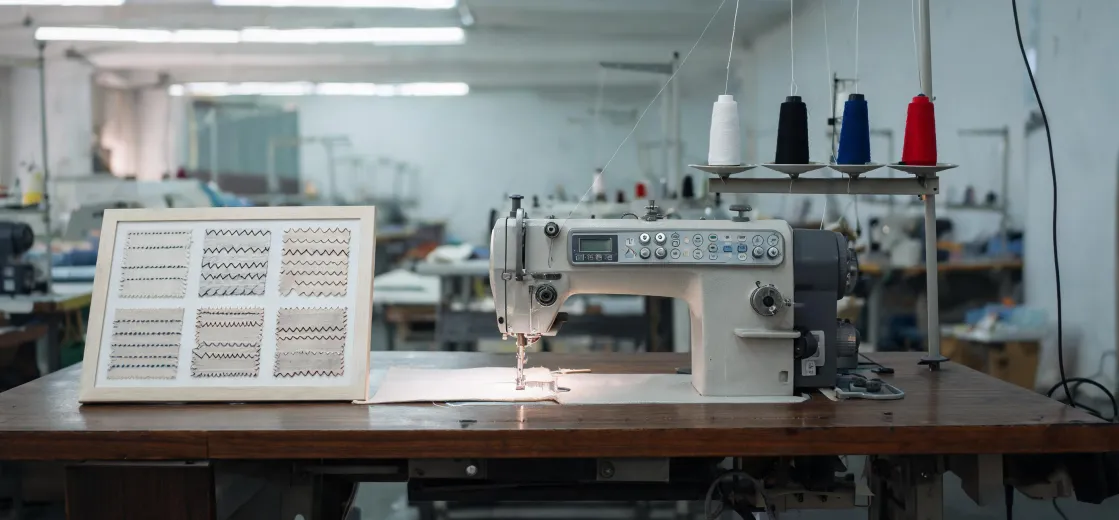
If you're running a production line, the conversation starts and ends with the Jack A-series and F-series lockstitch machines. These are direct-drive, high-speed units designed for exactly one thing: stitching fabric at 4,000-5,000 stitches per minute without stopping.
In March 2024, we had a client call at 7 AM needing four industrial lockstitch machines delivered and running by the following Monday. Normal procurement lead time was 12 days. We paid $600 extra in expedited freight on top of the $8,200 base cost for four units, and delivered Wednesday. The client's alternative was outsourcing a 2,000-piece order at 3× margin hit. Easy call.
For this scenario, here's what matters more than model number:
- Direct-drive vs. belt-driven: Direct-drive (like the Jack A2/A4 series) uses less power and has fewer wearable parts. At 10 hours/day, that difference compounds.
- Auto-lubrication system: If you're running multi-shift, manual oiling is a maintenance debt you'll pay for later. Skip it.
- Parts availability: This is where Jack's global distribution actually helps. In my experience sourcing parts for multiple brands, Jack's parts network is dense—at least in the regions where they've established distribution (Uzbekistan, Egypt, parts of Southeast Asia). At least, that's been our experience with their supply chain.
"We lost a $15,000 contract in 2022 because we tried to save $800 on a non-industrial machine for an industrial job. The machine seized after 6 weeks. That's when we implemented our internal 'Scenario A only gets Scenario A equipment' policy."
Looking back, I should have known better even then—the specs were clear. But at the time, the price gap looked bigger than the risk.
Scenario B: Prosumer Embroidery—Where Most Buyers Actually Land
This is the hardest category. "Prosumer embroidery machine" searches are dominated by buyers who don't yet know if they're Scenario B or Scenario C. And Jack's single-head and multi-head embroidery machines sit right in this space.
I went back and forth between recommending a multi-head unit and a single-head setup for a client last quarter. Multi-head offered 6× output. Single-head offered 1/4 the footprint and half the cost. Ultimately chose single-head with a plan to scale because their order volume couldn't justify the multi-head utilization rate—you don't buy a 6-head machine to run 20 pieces a day. The math just doesn't work. But it was close, I'll admit.
When I'm evaluating embroidery machines for this scenario, I check three specs that actually predict your experience:
- Max embroidery field size: If you're doing standard left-chest logos, a 14"×20" field is generous. If you're doing jacket backs or large designs, you need more.
- Thread color changes: Automated color change is not optional if you're running multi-color designs in any volume. Manual rethreading at 8 colors per design will destroy your throughput.
- Pantone matching capability: A subtle detail—the industry standard color tolerance is Delta E < 2 for brand-critical colors. Delta E of 2-4 is noticeable to trained observers; above 4 is visible to most people. If you're embroidering corporate logos, your machine's color reproduction needs to hit that tolerance. Check whether your thread library allows custom color matching. (Reference: Pantone Color Matching System guidelines)
One more thing about the mini embroidery machines you see at trade shows and in "embroidery machine mini" searches: these are Scenario C tools. They're excellent for proofing and small runs. They are not designed for even moderate production. I made that mistake early on—bought a mini unit "to start" and ran it 4 hours a day for three weeks. The tension assembly needed replacement by week two.
Scenario C: Sample Rooms and Startups—Where Jack's Smaller Units Shine
Scenario C buyers need to prototype, sample, and test before committing. For Jack, this means their single-head embroidery machines and the smaller industrial units that don't carry the full production duty rating.
The counterintuitive advice here: buy slightly more machine than you think you need. Sample rooms have a way of turning into small production rooms. That "temporary" proofing machine becomes your backup when your main unit goes down. I've seen this exact progression at three different shops. In all three cases, the buyers who bought the entry-level unit ended up replacing it within 14 months. The ones who stretched to the next tier kept it for 3-4 years as a dedicated sampler.
If you're genuinely in Scenario C and staying there, the mini embroidery machines are fine. But be honest about your 12-month trajectory, not your current state.
How to Tell Which Scenario You're Actually In
Before you buy any Jack sewing machine—or any brand, for that matter—run through these three questions:
- What's your daily run-time under load? Not peak day. Average day. If it's under 3 hours, Scenario C. 3-6 hours, Scenario B. 6+, Scenario A.
- What happens when the machine stops? If the answer is "we lose $500/hour in production," you're Scenario A and you already know it. If it's "we delay a sample by a day," you're Scenario C.
- Are you scaling down or up in the next 12 months? Buy for where you'll be, not where you are. But be honest—not optimistic.
For the official Jack sewing machine models list and current specifications, the jack sewing machine official website has the full catalog with regional configurations. (Verify current pricing and availability directly, as model availability varies significantly by region—I can confirm from my own sourcing that the Uzbekistan and Egypt markets carry different configurations than what I've seen in other regions.)
The 2017 "best industrial embroidery machine" comparisons you still see floating around? Most of those models have been updated or replaced. The core principles I've laid out above haven't changed—which is why I still use this framework. But check current specs, not decade-old reviews.
Choosing a machine is like choosing a vendor: the one that admits what they're designed for is more reliable than the one that claims to do everything. Jack's lineup has clear boundaries between their production-grade and prosumer units. Respect those boundaries, and the machine will outlast your expectations. Ignore them, and you'll learn why "it's cheaper" and "it works" are two different claims.

Pavel Novak
Pavel Novak is a commercial floor-care equipment analyst specializing in walk-behind and ride-on scrubbers, sweepers, pressure washers, and combined cleaning machines for retail, hospitality, logistics, and industrial sites. He applies IEC 60335-2-72 to applicable floor-treatment machines while comparing cleaning path, brush pressure, solution and recovery capacity, filtration, runtime, productivity rate, maneuvering envelope, gradient limit, noise, and charging time. His selection guides help facility teams size equipment around floor type, soil load, aisle geometry, shift duration, operator access, and maintenance resources.