Jack sewing article
SmartStitch vs Capella: Which Jack Embroidery Machine Actually Fits Your Line?
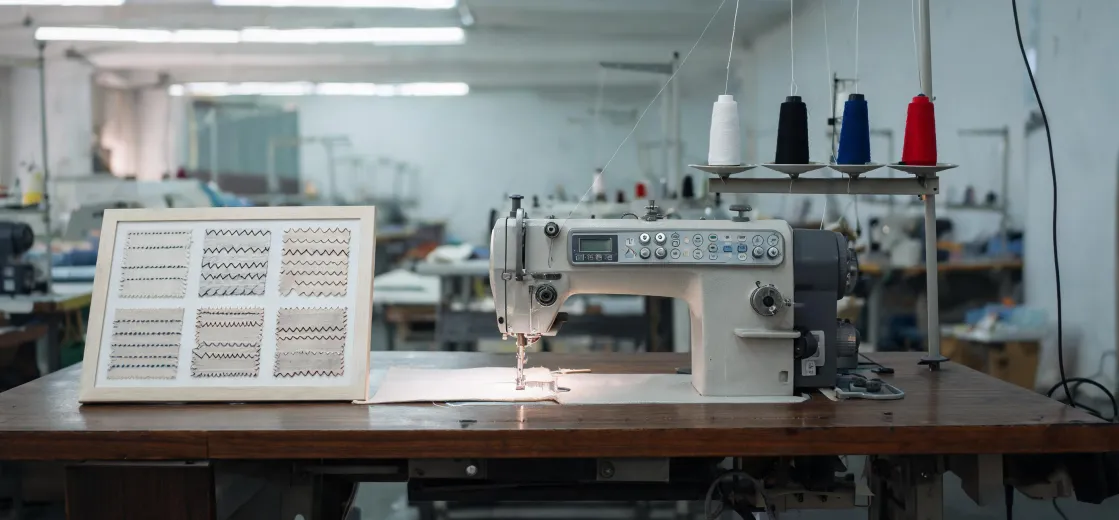
Two Machines, One Decision
I manage equipment procurement for a 200-person manufacturing operation—roughly $150,000 annually across about a dozen vendors. Last year, we needed to add embroidery capacity, and two Jack models kept coming up in every conversation: the SmartStitch and the Capella.
If you've been searching for "juki jack sewing machine" or trying to figure out whether Jack is a Juki sub-brand or something else entirely—they're separate manufacturers competing in overlapping markets. But that's a different article. This one is about the choice I actually had to make: SmartStitch or Capella.
I spent three months comparing them, talked to four distributors, and ran test orders on both. The honest truth: these two machines target different realities. The question isn't which is "better"—it's which fits your specific order profile. I'll compare them across four dimensions: volume match, setup complexity, total cost of ownership, and service footprint.
Dimension 1: Volume Match—Where the Gap Actually Shows Up
This seems like a no-brainer, right? SmartStitch handles bigger runs, Capella handles smaller ones. That's the marketing line.
The reality is messier. The SmartStitch shines when your orders stay above 200 pieces per design. But if you're running 50–80 piece batches with lots of color changes—which is what we actually do—the SmartStitch's setup overhead eats the throughput advantage.
Wait, setup overhead? On the SmartStitch, each additional head multiplies the thread tension adjustments. Going from 6 to 12 heads doesn't double your setup time—it more than triples it (I timed it: 45 minutes to 2 hours 40 minutes). The Capella, with fewer heads, gets you from design file to first stitch in under 35 minutes consistently.
So here's the counterintuitive take: if your orders are small but frequent, the Capella gets more done in a 10-hour shift than the SmartStitch.
The SmartStitch wins when you have one large design, few color changes, and a dedicated operator who runs it all day. The Capella wins when you're switching designs every 2–3 hours.
Dimension 2: Setup and Operator Skill—The Hidden Bottleneck
The most frustrating part of equipment procurement: the demo always runs with the manufacturer's best operator. You'd think that's a fair test, but your third-shift operator isn't that person.
I brought two of our regular operators to test both machines. Here's what happened:
- SmartStitch: Our senior operator got it running in a day. Our newer operator needed a week before the defect rate came down to acceptable levels.
- Capella: Both operators were producing sellable output by day two.
That gap matters more than the spec sheet suggests. A machine your team can't run efficiently is a machine that sits idle. And idle machines don't pay for themselves.
The SmartStitch's interface is more capable—more parameters, more control. But more control means more ways to get it wrong (one mis-set tension value on head #7 kept us troubleshooting for two hours).
Dimension 3: Total Cost—The Invoice Isn't the Whole Story
Early in my purchasing career, I compared sticker prices and thought I was comparing costs. After five years of managing equipment budgets, I know better.
Total cost includes:
- Base machine price
- Power consumption (the SmartStitch's 12-head config draws 30–40% more power than the Capella)
- Operator training time (real cost, not theoretical)
- Spare parts availability and lead times
- Downtime risk
For our usage pattern, the Capella came out roughly 18% cheaper over three years—mostly from lower power draw and faster operator ramp-up.
But here's where I have to be honest: for a factory running large orders with experienced operators, the SmartStitch's per-piece cost drops well below the Capella. The machine pays for itself faster.
It depends entirely on what you're actually running.
Dimension 4: Service and the Official Website Question
Search "jack sewing machine official website" and you'll find a dozen results. Not all are the manufacturer.
You know what the red flag is? If a distributor can't show you a direct authorization letter for Jack embroidery machines, you're buying gray-market. That means no warranty support on the control boards, and parts lead times stretch from 5 days to 5 weeks.
Both the SmartStitch and Capella use standard embroidery needle sewing machine components for the needle assembly—that's good news. Common consumables are widely available. But the specialized parts (the tension regulators, the color-change mechanisms) are model-specific.
The problem wasn't the machine itself—it was what happened six months after we bought one. The vendor vanished, and we were left with $1,800 in parts we couldn't source. That incident changed how I evaluate every equipment purchase now.
I still kick myself for not checking authorization before that earlier order. If I'd spent ten minutes verifying the distributor's credentials, we'd have avoided the whole mess (and I wouldn't have spent three weeks explaining the write-off to finance).
So Which One?
Choose the Capella if:
- Your average order is under 150 pieces
- You change designs frequently (multiple times per shift)
- Your operators rotate or aren't deeply specialized
- Power costs are a meaningful line item for you
Choose the SmartStitch if:
- You run 300+ piece orders regularly
- You have dedicated operators who run the same design for days
- Your bottleneck is throughput, not flexibility
- You can absorb the longer setup time in exchange for lower per-piece cost
One more thing: don't ignore the small-batch reality. We started with a single Capella to test whether embroidery was even a service we should offer. That $8,000 test order? Turned into a $60,000 program over 18 months.
Small doesn't mean unimportant—it means potential. The vendors who took our small first order seriously are the ones still quoting us today. The ones who brushed us off because we weren't buying a full production line? I don't even remember their names.

Henrik Solberg
Henrik Solberg is a commercial machinery safety, reliability, and procurement analyst covering display, audio, printing, sewing, cleaning, laser, welding, and supporting automation systems. He applies ISO 12100 risk-assessment principles and IEC 60300-3-3 lifecycle-costing guidance while comparing uptime, MTBF, MTTR, energy use, consumable demand, preventive-maintenance intervals, spare-parts lead time, training burden, installation constraints, and residual risk. His decision frameworks help plant managers, integrators, and procurement teams compare quotations, validate operating assumptions, plan acceptance tests, and select equipment on total delivered value.