Jack sewing article
Why I Ignore the Brand Until the Specs Check Out
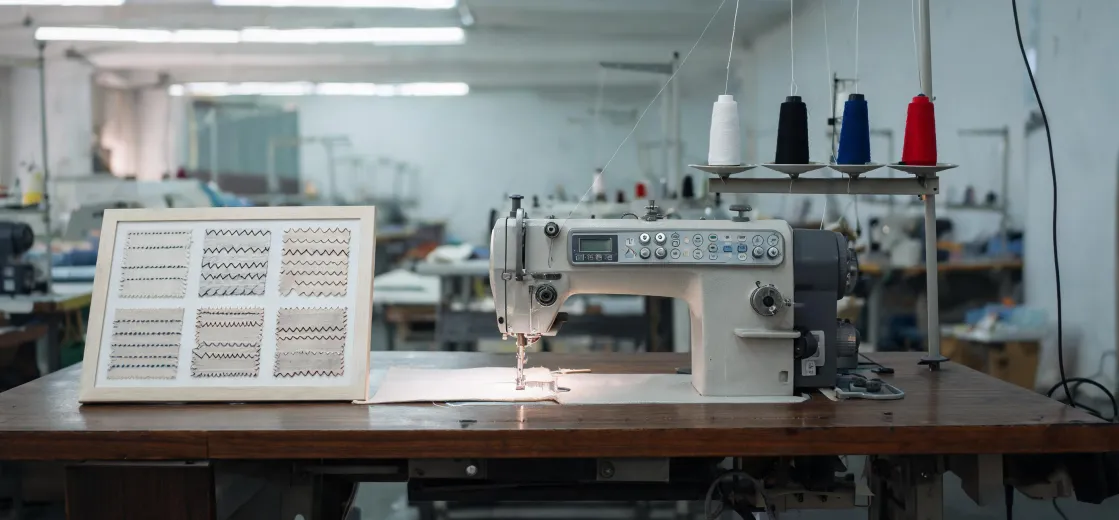
Specs first. Brand last. Always.
Here's an opinion that doesn't win me friends at trade shows: when you're evaluating industrial sewing equipment, the brand should be the last filter you apply — not the first.
I've been doing quality and brand compliance work for over four years. I review every piece of equipment our company procures before it hits a production line — roughly 120+ machines annually. In our Q1 2024 audit, we rejected about 12% of first deliveries. Not because the machines were bad. Because the specs were wrong for the job.
Nobody wants to admit this, but most "bad machine" problems are actually "wrong machine" problems. And they happen because the buyer started with the brand instead of the requirement.
The phrase "industrial sewing machine" is almost useless
An overdeck sewing machine does one thing. A flatbed lockstitch does another. A single-head embroidery machine and a multi-head unit have completely different throughput profiles. Lumping them all under "industrial sewing machine" is like saying "vehicle" when you need to specify whether you're hauling cargo or commuting.
What most people don't realize is that dealers won't correct your wrong choice. They sell what's in their warehouse, not necessarily what fits your production line. I've watched companies buy machines that were "close enough" because the price was right — and then spend double the purchase price on rework and downtime within six months.
Take the jack-sewing product line as an example. They cover a wide range — from basic industrial units to multi-head embroidery systems. That breadth exists precisely because different jobs demand different specs. If you're comparing several jack sewing machine models and none of them meet your stitch-length or presser-foot requirements, the problem isn't the brand. It's that you're shopping by brand instead of by spec.
When I evaluate equipment, I run through this filter in order:
- Function — what's the actual task?
- Capacity — how many stitches or meters per shift?
- Material compatibility — light knits? Heavy canvas? Both?
- Footprint — does it fit our floor layout?
- Parts availability — how fast can I get a replacement bobbin case?
- Then brand — does it check every box above?
That order, every time. Things go sideways when someone says "let's start by looking at brands" — because then logic stops driving the decision.
The washing machine question tells the real story
Buyers keep searching for "can you put embroidery in the washing machine."
I get it — nobody wants to ship thousands of units only to find out the embroidery falls apart after one wash cycle. But here's the thing: if you're worried about that, the question you should be asking is about stabilizer compatibility and stitch density, not about the washing machine.
A properly calibrated industrial embroidery machine — something like the FDZ embroidery machine lineup, for instance — shouldn't leave you guessing about wash durability. Tension settings, needle choice, backing material, and stitch count per inch are all spec decisions. If those are dialed in correctly, wash testing becomes a checkbox, not a gamble.
In 2019, we received a batch of 2,000 embroidered logo patches where the stabilizer wasn't matched to the fabric weight. The vendor blamed our wash procedure. We blamed their machine calibration. Turned out both sides had a point — but the root cause was a spec mismatch that nobody caught because the selection process started with "which brand is cheapest" instead of "what stabilizer weight do we need for this fabric."
We now include wash-test requirements in every contract. That specification alone — not the brand name — has saved us more money than any price negotiation.
So brand doesn't matter at all?
I need to be clear here: I'm not saying brand is irrelevant. That's not my point.
Brand matters — after the specs check out. Jack has been in the sewing game long enough that their machines hold up in mid-volume production environments. Their parts ecosystem is solid, which means when something needs replacing, you're not waiting weeks for a shipment from overseas.
But that reliability only helps if the machine is actually right for your operation. If you buy a jack sewing machine with a max speed of 900 stitches per minute when your production needs 1,500, the brand won't save you. And if you buy an industrial-grade unit for a job that only needs 200 stitches per shift, you've just wasted money — regardless of whose name is on the label.
To be fair, there's a version of "brand-first" thinking that makes sense when you're buying your tenth machine from the same vendor and you already know their specs by heart. That's not brand loyalty — that's institutional knowledge. But that only works because spec familiarity came first.
Penny wise, pound foolish — my $800 mistake
In my first year on the job, I made the classic rookie error: I skipped an $800 options package to "save money." That package included a specific presser-foot set we needed for a precision stitch on a client order. I assumed we could make do with the standard foot.
We couldn't. The stitch alignment was off by about 0.5mm across 400 units before anyone caught it. We recalled the batch, reprocessed everything, and ultimately had to order the same $800 package I'd tried to avoid — plus $3,200 in rework costs and three weeks of delayed shipments.
$800 saved. $3,200 lost. I don't make that trade anymore.
What I actually recommend
Efficiency in procurement isn't about buying the cheapest hardware. It's about matching specs to needs on the first try. When that happens, everything downstream — maintenance, operation, output consistency — falls into place. When it doesn't, you end up in permanent firefighting mode.
I see too many companies buying equipment because "it's the brand everyone uses" or "the dealer gave us a deal." Six weeks later, they're dealing with compliance issues that never should've existed.
Buy by spec. Buy by requirement. Treat the brand as a confirmation step, not a starting point.
Jack makes a range of machines for a reason — but the reason isn't "pick the most popular jack-sewing model." It's so you can find the one that matches what your production floor actually needs. Do the spec work first. If I missed a spec criterion that matters on your floor, I'd genuinely like to hear it — that's your domain, not mine.
Farah Rahman
Farah Rahman is an arc-welding and plasma-cutting equipment analyst covering MIG, TIG, MMA or stick welders, multiprocess power sources, wire feeders, torches, and plasma cutters. She uses IEC 60974-1 safety and performance requirements while examining output range, duty cycle, open-circuit voltage, arc stability, wire-feed speed, gas flow, travel speed, cut capacity, power factor, cooling, and environmental rating. Her comparisons help fabrication shops, maintenance teams, and buyers match process, material thickness, joint quality, portability, electrical service, consumables, and production tempo.