Jack sewing article
Why Your Industrial Sewing Machine Is Failing (And It's Not the Brand You Bought)
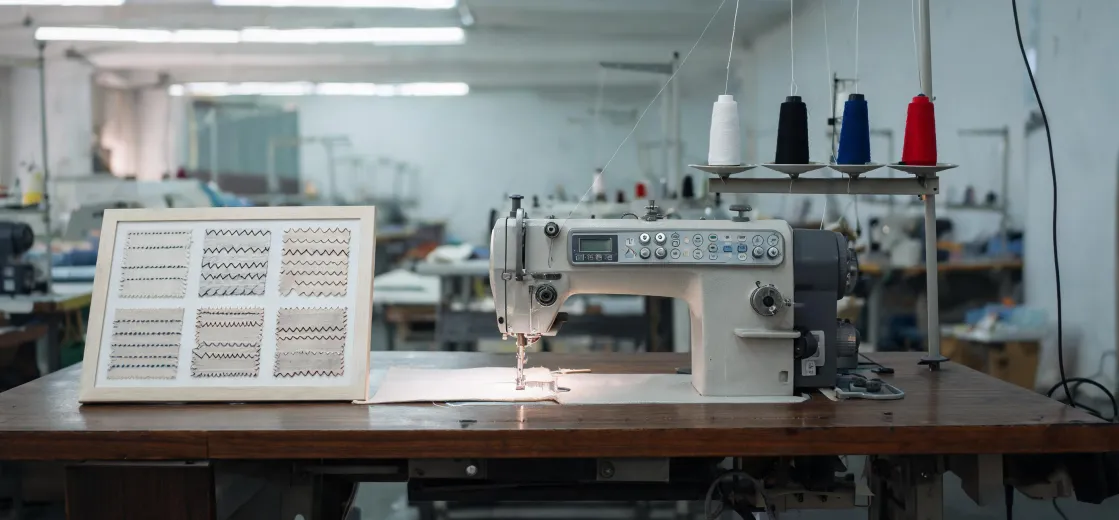
You Need a Repair on an Industrial Sewing Machine—And You Probably Should Have Seen It Coming
It almost always starts the same way. A line breaks mid-shift. The tension drifts. An operator says, "It was fine yesterday, now it just won't cooperate." And now you're searching for a servis sewing machine—not because you want a new machine, but because you need someone who can fix the one you have before you lose another day of production.
I've been on that side of the equation more times than I can count. I'm a quality and brand compliance manager at a garment manufacturing company. I review every piece of equipment before it goes to the floor—roughly 400 units a year across different brands and price points. Our fleet includes double stitch industrial sewing machines and multi-head yarn embroidery machine setups.
In Q1 2024, I rejected 23% of first deliveries due to alignment and tension inconsistencies. Not one brand. Multiple vendors. And here's what surprised me: arrival defects had almost no correlation with six-month failure rates. Some machines arrived out of spec, got corrected, and ran flawlessly for years. Others arrived perfect and started acting up within four months.
That's when I stopped blaming the machine. The problem was never the machine.
The Problem You Think You Have
"I bought a lemon." Or "I should have paid more." Or "This brand is garbage."
I understand the instinct. When you spend real money on a double stitch industrial sewing machine and it starts acting up six weeks in, it feels like a betrayal. You did the research. You compared specs. Maybe you chose a jack-sewing machine over another brand because the price-to-capability ratio looked right. Maybe you searched "jack sewing machine price algeria" or "jack sewing machine usa" and thought you'd found the best deal in your market.
Then reality hits.
This is the default reaction—blame the equipment. But every single time I've investigated a persistent machine problem, that assumption fell apart.
The Real Problem—And Why It's Almost Never the Machine
Here's what I've learned from reviewing deliveries and tracking actual performance: industrial sewing machine failures are almost always about what surrounds the machine, not the machine itself.
1. Installation Environment
Industrial machines are sensitive to power fluctuation. To humidity. To vibration. To air pressure—both double stitch and yarn embroidery machines need stable compressed air. If your power supply is inconsistent, your machine will behave inconsistently. If you're running it in an unconditioned space in a climate that swings, your tension will swing with it.
I learned this the hard way. We had a production floor with voltage issues during peak summer months. Machines that had run perfectly for years started skipping stitches we'd never seen before. We blamed the machines. Turned out the incoming voltage was fluctuating between 170V and 240V within a single day. A $400 voltage stabilizer solved what a $4,000 machine replacement couldn't.
2. Consumables—Or More Precisely, the Wrong Consumables
When I started this role, I assumed "same specifications" meant identical performance across suppliers. I didn't verify. Turns out each vendor had slightly different interpretations of what "matching" meant—differences big enough to affect stitch quality.
Now every contract we sign includes specific thread weight, twist direction, and needle size requirements. Not because I'm difficult—because a $3 cheaper thread spool can cost you 200 defective pieces at $11 each. That math only works one direction.
3. Training—The Thing Nobody Thinks They Need
You hand a new double stitch industrial sewing machine to an experienced operator. They know what they're doing. But do they know this machine? Every model has different tension adjustments. Different threading paths. Different responses to different fabrics.
Most "machine problems" in this industry are actually "operator hasn't learned this specific machine" problems. That's not a knock on the operator—it's a gap in how machines get handed off.
4. The Service Ecosystem—Or Lack of It
A service network isn't something you find in a pinch. It's something you build before the pinch happens. The buyers who line up a local technician before they need one—weeks before, not the day the machine goes down—get faster service. Simple as that.
There's a reason "servis sewing machine" is a common search term. People are looking for help after the fact. The ones who aren't searching are the ones who already have a relationship in place.
What It Costs to Ignore This
The one that still bothers me involved a $22,000 redo on an 8,000-unit order because the stitch quality didn't meet spec on the first pass. The customer had a deadline. We missed it. Overtime, expedited shipping, and a very uncomfortable phone call followed.
The root cause? Not the machine. Not the operator. A mismatch between thread quality and our machine's tension settings that nobody caught until it was too late.
None of that $22,000 was spent on equipment. All of it came from a problem we didn't see coming.
Here's the thing: when you buy an industrial sewing machine, you're not buying a machine. You're buying everything that machine will produce. If it underperforms because of environment, consumables, or training, that's a cost that shows up on your P&L, your delivery schedule, and your customer satisfaction scores.
A machine down for three days at a shop producing 5,000 pieces a week means somewhere north of $14,000 in lost output—plus the calls you have to make explaining why orders are late.
FTC guidelines on advertising and business claims exist for a reason—claims should be truthful, substantiated, and not misleading. I'd suggest applying a similar standard to your equipment decisions. If a vendor can't clearly explain what specifications mean, that's a signal.
How to Get This Right: A Pre-Purchase Checklist
I've seen enough failures to be careful here: no guarantee exists. Every machine, shop, and order is different. But these four questions would have saved us real money more than once:
- Who is my local service contact, and how quickly can they reach me? Not the dealer—the person who actually comes on-site.
- What are the exact consumable specifications for this machine? I want a written spec, not a "recommended brand."
- How much does my power fluctuate in a 24-hour period? If I haven't measured it, I'm guessing.
- Has my operator been trained on this specific model? Not "industrial sewing" training—this machine.
If you're a small shop or a startup, these questions matter even more. I know the feeling of being treated like a small order doesn't deserve real answers. When I was starting out, the vendors who treated my $200 order seriously are the ones I still use for $20,000 orders. Small doesn't mean unimportant—it means potential.
So before you blame the machine—or replace it—ask those four questions. The answer is probably there.
The machine is usually fine. The problem is almost always something else.

Adrian Okafor
Adrian Okafor is a professional audio systems analyst specializing in loudspeakers, PA speakers, subwoofers, line arrays, stage monitors, power amplifiers, and audio mixers. He uses IEC 60268-5 measurement methods for applicable passive loudspeakers while comparing frequency response, sensitivity, maximum SPL, nominal impedance, dispersion, crossover behavior, amplifier headroom, limiter settings, and rigging loads. His system guides help sound designers, rental companies, venues, and installers match acoustic coverage, audience capacity, deployment geometry, power distribution, monitoring needs, and safe operating margins.