Jack sewing article
Jack Sewing Machine Price in the USA: FAQ on Embroidery Machines That Make Patches
-
Is Jack-Sewing a real brand in the USA?
-
Jack sewing machine price in the USA: what should I budget?
-
Which embroidery machine makes patches?
-
What does “embroidery sew machine” mean?
-
Why do www.husqvarnaviking.com embroidery machines show up next to Jack?
-
Single-head or multi-head for patch production?
-
What hidden costs should be in your Jack sewing machine budget?
-
When should you NOT buy an embroidery machine that makes patches?
I don't repair sewing machines. I buy them—or, more precisely, I make sure the people who run them have what they need. Since 2021 I've handled purchasing for a 120-person custom apparel company: roughly $200,000 a year in equipment, parts, embroidery outsourcing, and supplies. This FAQ is the guide I wanted when “jack-sewing” and “embroidery machine that makes patches” kept showing up in the same search results. Prices below come from dealer quotes I reviewed in early January 2025; verify current pricing before you approve a purchase.
Is Jack-Sewing a real brand in the USA?
Yes. Whether you spell it “Jack” or use the domain-style “jack-sewing,” it is the same industrial sewing and embroidery equipment brand. It is not the kind of machine you buy at a big-box craft retailer. The normal US route is through an authorized dealer or distributor who handles parts, installation, and service.
When I searched for jack sewing machine usa suppliers, the useful results were from industrial apparel equipment dealers. The term “jack-sewing” also shows up on parts and component sites, which is a good sign for maintenance. But it means you should check every local dealer's service capacity before committing. A machine brand matters less than the technician who shows up when it breaks.
Jack sewing machine price in the USA: what should I budget?
Be careful with the phrase “jack sewing machine price.” It covers an industrial sewing machine and an embroidery machine, and those are two very different budget conversations. In January 2025, dealer quotes I reviewed for basic industrial single-needle machines with a table, stand, and servo motor landed around $1,700 to $2,600. Automated models with thread trimming and extra features were closer to $2,800 to $4,500. That spread came from current dealer quotes, not an official list price—industrial equipment rarely has one list price.
Embroidery changes the math. A single-head embroidery machine starts well above an ordinary sewing-machine price, and a multi-head production unit can be five or six figures before installation. Actually, the useful number is not the sticker price. It is the total cost to make your first good patch—including software, training, digitizing, and test materials.
Which embroidery machine makes patches?
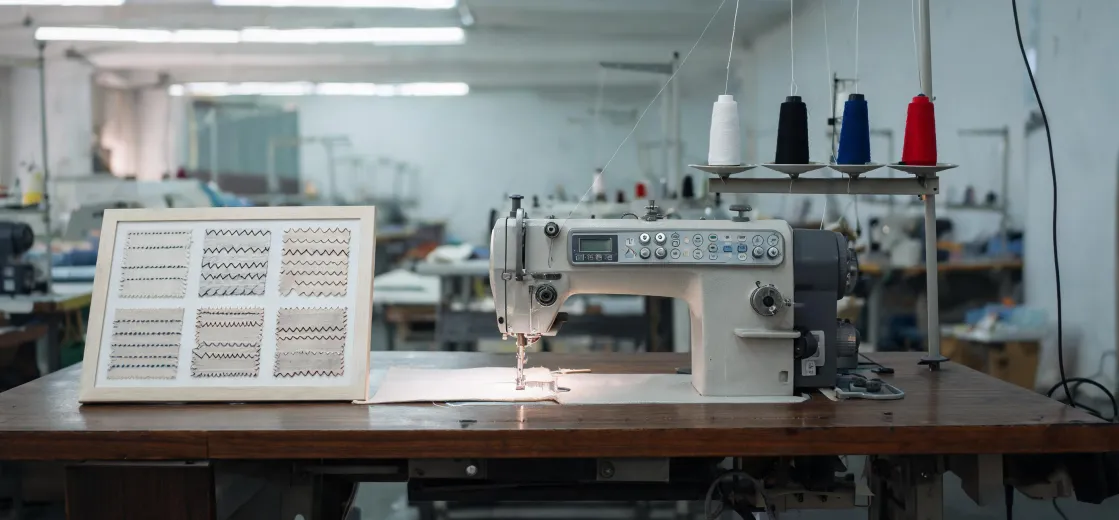
“Embroidery machine that makes patches” is not a specific machine category. Patch production is a workflow: embroider dense designs onto fabric, cut around them, and finish the edge. The machine needs stable tension, a good hoop system, and enough field size for your largest patch.
For a serious patch shop, I'd prioritize a multi-needle embroidery machine because most patch designs use several thread colors. A single-needle home machine can make patches if you manually change thread for every color. That works for a hobby project. It doesn't work for a 200-piece order due next week. If you are starting out, ask the dealer for a demo using a dense satin-stitch letter file before deciding.
What does “embroidery sew machine” mean?
“Embroidery sew machine” is a search phrase that mixes three categories:
- a sewing machine with decorative stitches, not a machine that reads digital design files;
- a dedicated embroidery machine that follows a computer file; or
- a sewing and embroidery combo that tries to do both.
For patches, the dedicated category is usually the right one. In our shop, we keep seam work and embroidery on separate machines. Running a patch order on a combo machine causes frequent thread changes, smaller hoop options, and slower daily output. No single machine is perfect for every task—and the people who admit that are easier to work with.
Why do www.husqvarnaviking.com embroidery machines show up next to Jack?
If you have typed “jack-sewing” and “www.husqvarnaviking.com embroidery machine” into the same search session, you are comparing two different product worlds. The Husqvarna Viking brand's home embroidery machines are built for individual sewists, crafters, and small projects. Jack's commercial sewing and embroidery equipment is built for shops that need repeatable production. I don't see that as one being better. It's a volume, skill level, and service expectation question.
A home-class machine can make beautiful patches for gifts or a small Etsy batch. It will feel slow when you're watching a production calendar. A higher-priced embroidery machine can also make a beautiful patch, but you're paying for speed, multiple needles, larger hoops, and longer run capacity. Choose based on output, not just price.
Single-head or multi-head for patch production?
When our team reached this decision in 2024, the upside of a multi-head machine was a much lower unit cost on repeat orders. The risk was a large capital expense, an extra operator, and the possibility that order volume wouldn't keep the machine busy. I kept asking myself whether the savings justified that risk.
In practice, a single-head machine is easier to justify for samples, custom one-offs, and short runs. A multi-head machine makes sense when you have enough repeatable orders to run it on a schedule. Between those points, contract embroidery services are the least risky bridge. Even after we signed the purchase order for the Jack single-head, I kept second-guessing. What if the multi-head price dropped after we bought? What if the single-head couldn't handle a rush order? I didn't relax until the third clean production run went out on schedule.
What hidden costs should be in your Jack sewing machine budget?
The most frustrating part of comparing quotes was that they didn't all include the same pieces. One dealer's price included the table and motor. Another quote covered the machine head only. When I did an itemized comparison, the supposedly cheaper option wasn't cheaper.
Before you approve the purchase, confirm these items:
- Delivery, rigging, installation, and operator training
- Digitizing software and training for whoever will use it
- Thread, stabilizer, hoops, needles, bobbins, and test materials
- Ongoing maintenance, parts availability, and service response time
A good service plan costs more than a box of spare parts. The first time a machine is down in the middle of an order, your production manager will explain why. Trust me.
When should you NOT buy an embroidery machine that makes patches?
If you only need embroidered patches occasionally, don't buy one. Start with a contract embroidery provider. That sounds like an odd sentence in an article about Jack sewing machine prices, but the timing question matters more than the machine question.
For our company, the right time came when patch demand became more predictable than our event calendar. Before that, outsourcing was more expensive per patch but carried no equipment risk. The strongest supplier relationship I have came from a sales rep who said, “this isn't our specialty—here's who does it better.” That honesty made me trust him for jobs he could handle. If you're comparing Jack machines, ask dealers which tasks they would not recommend for Jack. Their answer is often the most useful part of the pitch.

Elise Marceau
Elise Marceau is an LED display and digital-signage systems analyst covering LED video walls, modular screens, transparent LED, control processors, and indoor or outdoor signage. She applies IEC 62368-1 safety principles while comparing pixel pitch, luminance, contrast, refresh rate, colour uniformity, viewing angle, ingress protection, power density, module serviceability, and signal redundancy. Her specification guides help integrators, venue operators, retailers, and procurement teams align viewing distance, ambient light, content format, installation access, electrical load, and lifecycle support.