Jack sewing article
48 Hours to Save a 12-Head Embroidery Line: A Rush Parts Story
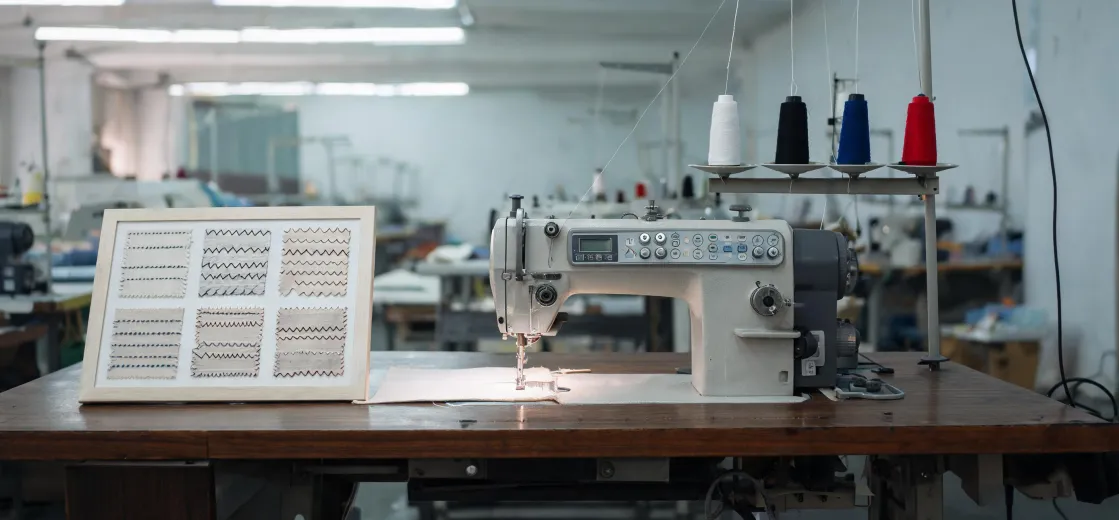
Thursday, 2:47 PM. The call came in while I was mid-way through inventory.
"The 12-head is down. We've got 48 hours before the biggest order of the season ships."
I'd worked with this client for three years. They run a mid-sized embroidery shop — custom apparel, corporate uniforms, that kind of work. When they said 48 hours, they meant it. Their alternative was explaining to a hotel chain why 1,800 uniform shirts weren't done.
Here's the part I should be honest about: my first question wasn't "what machine do you have?" It was "what's the symptom?" And that's where the real story starts.
The Vague Problem Report
"The stitching is skipping," the client said.
That's it. No photo. No video. No part number. Just "skipping."
Skipping could mean a dozen things: a bent needle, the wrong needle for the fabric, tension imbalance, bad thread, hook timing, or a damaged hook point. I have seen machines skip for every one of those reasons.
I asked for a photo. They sent one. The embroidery loops were loose on top, with thread breaks every few thousand stitches.
Not a tension issue. A timing issue. A broken hook tip, almost certainly.
We were using the same words but meaning different things. Found that out when the photo arrived. They'd been saying "stitching is skipping" while I had been mentally preparing a tension-fix script. The reality was mechanical, not adjustmental.
(Should mention: the machine was a 6-year-old multi-head from a brand they'd bought at auction. Not a Jack. But that's the point — when production stops, you don't care about the nameplate. You care about who can get parts quickly.)
The Parts Hunt
Their regular supplier quoted five to seven business days for the hook assembly. Useless. The order shipped in 48 hours. The install would take most of a day.
So I started calling around.
This is where the industry surprised me. And honestly, this is what changed how I've approached every emergency since.
The quickest path wasn't through the original equipment manufacturer. It was through a network of independent parts distributors who stock compatible components — much of it sourced from China's major industrial sewing machine manufacturers, including jack-sewing.
Jack has become a significant name in industrial sewing. Their machines are everywhere — garment factories, upholstery shops, embroidery studios. In my role coordinating equipment repairs for these businesses, I've noticed that "jack sewing machine parts" is one of the most common search terms among shop owners. That's not an accident. The brand's manufacturing footprint in China is large, and because of that, compatible parts are widely available at reasonable prices.
A lot of people ask, "jack sewing machine made in which country?" The answer: China. That's a supply-chain fact, not a judgment. It means the parts ecosystem is deep. Distributors stock compatible components for Jack machines because so many workshops run them.
For the hook assembly we needed — a common style used across several multi-head machines — we found a compatible set from a distributor in a neighboring state. Price: $210 for the assembly, plus $40 for overnight shipping. The OEM equivalent: $380, seven days, no rush option. As of January 2025, those are the numbers I've seen in distributor price lists and my own purchase records.
That math wasn't difficult.
The Communication Breakdown
Here's where we nearly lost the entire order.
I confirmed the part number with the distributor. It was in stock. Then I called the client and said: "The part will be there Friday morning."
They heard: "Your machine will be fixed by Friday."
I didn't say that. They didn't ask. We were both in a hurry, and the gap between what I said and what they heard swallowed the buffer we'd built into the plan.
When Friday arrived and the part was in my hands but not yet installed, the client called, frustrated: "Why isn't the machine running?"
Because installing it, aligning the hook, and test-running it is six hours of work minimum. That work couldn't start until the part showed up at 9:40 AM — barely an hour inside our 48-hour window.
That was my fault. I should have said, "Part arrives Friday morning. Installation follows. Machine ready for test runs Friday evening." Not "it'll be there Friday." I said "as soon as possible." They heard "by Friday morning." I meant "by Friday if nothing goes wrong." Result: one tense hour that could have become a lost client.
The Real Gap: No Process
This was the third time a rush repair nearly went sideways because of vague communication. The first two times, I wrote it off as bad luck. The third time, I fixed it.
We didn't have a formal confirmation process for rush orders. No written timeline. No explicit definition of what "done" meant. That ambiguity was the real problem hiding under the parts problem.
So glad I paid the $40 for overnight shipping. Almost went standard to save the money, which would have meant missing the deadline entirely. Dodged a bullet.
Now I use a written checklist for every rush job:
- Exact part number and photo, confirmed by the technician who will do the install
- Written definition of "done" — installed, aligned, test-run, or all three
- Timeline in writing: "Part arrives Friday 10 AM. Install Friday 11 AM–4 PM. Test run 4 PM–6 PM."
Sounds basic. It is.
Nobody does this when they're in a hurry. And the rush is exactly when it matters most.
How It Ended
Part arrived: 9:40 AM Friday. One hour inside our window.
Installed: 1:00 PM. The technician adjusted hook timing — that's the alignment between needle and hook that determines stitch quality — and by 3:30 PM we were running test patterns on scrap fabric.
By 6:00 PM, the machine was producing clean, consistent embroidery stitching. Twelve heads. No skipped stitches. Eighteen hundred shirts, with two hours of buffer before the Saturday morning shipment.
The $12,000 order shipped on time. The hotel chain got its uniforms. The client has since referred two other shops to us.
But let's be clear: we got lucky. The part was in stock. The distributor was competent. The timing worked out. None of that is guaranteed next time. That's why the process matters.
What Changed — and What Hasn't
The sewing industry is evolving. What was best practice in 2020 may not apply in 2025.
Five years ago, if your multi-head machine broke, you went through the manufacturer's dealer network. That was the only option. Cross-brand compatibility was something people whispered about at trade shows, not something they relied on.
Today, the landscape looks different. Chinese manufacturers like Jack have grown dramatically. Independent parts distributors have built serious businesses around supplying compatible components for every major brand. The result: more choices, faster turnaround, and lower prices — for those who know where to look.
The fundamentals, though, have not changed. A machine is still a system of moving parts that wear out. Hook tips break. Timing drifts. Thread quality matters. Proper service — "servis sewing machine," as half the search queries in this industry spell it — is still the difference between a machine that runs for years and one that fails in the middle of your busiest week.
What has changed is the execution. The way you source parts, schedule repairs, and communicate expectations. The old playbook — call the authorized dealer, wait, pray — is no longer the only one. That's not a criticism of the past; it's an acknowledgment of how the market has transformed.
Let me rephrase that: the fundamentals are unchanged, but the playbook has shifted. Shops that treat the old playbook as gospel are often the ones calling me at 2:47 PM on a Thursday with a dead 12-head and a 48-hour deadline.
Practical Notes for the Next Emergency
If you operate an embroidery or garment production line, here's what I'd tell you — based on handling 200+ rush jobs in the last few years, not a theory:
Know what you have. Model, year, stitch system, serial number. Take a photo of the spec plate and keep it on your phone. When a part breaks, that photo saves hours.
Know where it was made. This matters more than people realize. "Jack sewing machine made in which country?" — China. That fact tells you a lot about the supply chain. It tells you parts will be available somewhere, quickly, at multiple price points.
Find two parts suppliers before you need them. One OEM, one independent. The OEM for guaranteed fit on critical components. The independent for speed and price when the machine is down and the deadline is real. If you've never searched for "jack sewing machine parts" or your machine's model number plus "parts" — do it now, not during a crisis.
Consider the market broadly. I see hobby sewists spending hours online with searches like "shop deals on husqvarna viking sewing machine." Those are good machines with solid reputations, and I get the appeal. But a Husqvarna Viking built for home and craft use isn't the same class of equipment as an industrial multi-head designed for production shifts. Different tools for different jobs. The right machine depends on the scale of your work, not just the brand's reputation.
Schedule your service. The best emergency is the one that never happens. A proper service every six to twelve months — cleaning, oiling, timing check, hook inspection — catches problems before they kill a production run. That's not theory; that's observation from two hundred-plus repair calls.
And if you're the one providing repair services: write down your process. Define what "done" means in writing. Because the difference between "the part will be there Friday" and "your line will be running by Friday evening" is the difference between a client who trusts you and a client who never calls again.
I've made that mistake. I'll probably make another one — maybe a different flavor, maybe the same thing under a new form of pressure.
But I'm making fewer mistakes every year.
That's the process working.

Elise Marceau
Elise Marceau is an LED display and digital-signage systems analyst covering LED video walls, modular screens, transparent LED, control processors, and indoor or outdoor signage. She applies IEC 62368-1 safety principles while comparing pixel pitch, luminance, contrast, refresh rate, colour uniformity, viewing angle, ingress protection, power density, module serviceability, and signal redundancy. Her specification guides help integrators, venue operators, retailers, and procurement teams align viewing distance, ambient light, content format, installation access, electrical load, and lifecycle support.